What Makes an Object an 'Oddity'? A Beginner's Explainer
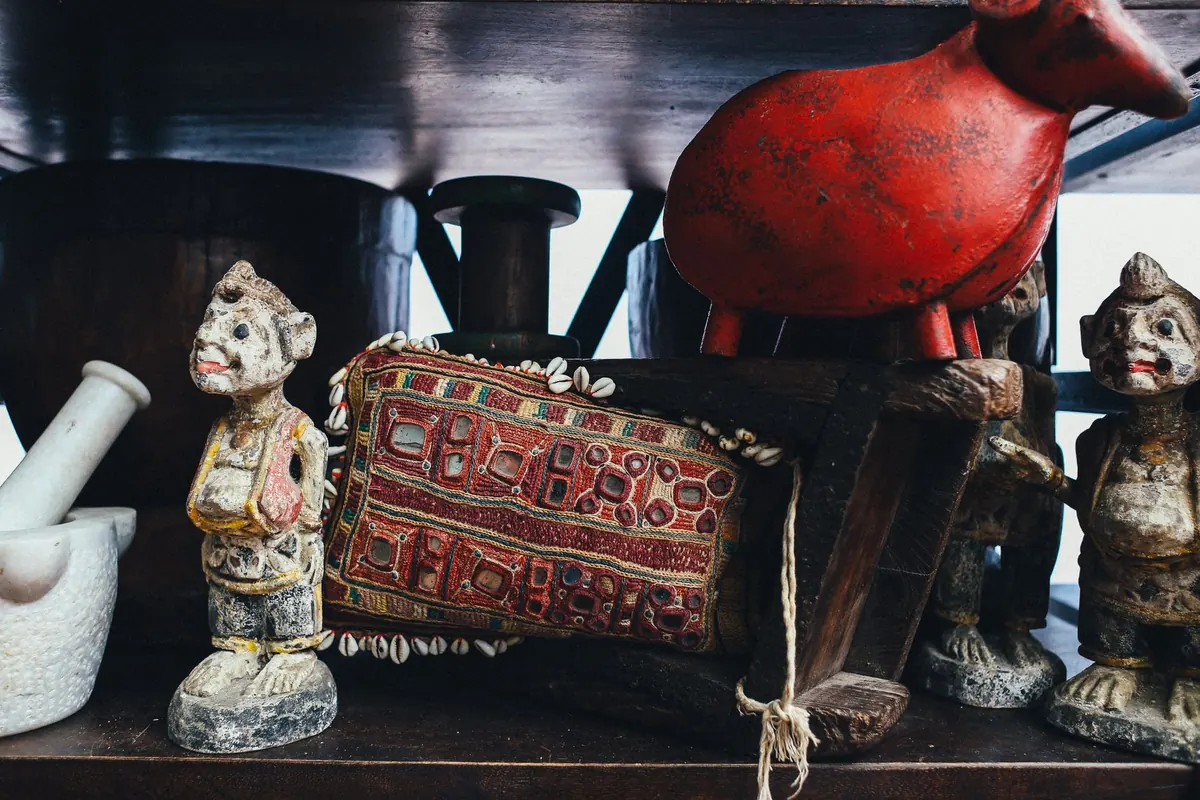
A glass eye in a velvet-lined box. A mousetrap carved from a walnut shell. A hand-painted sign rescued from a demolished funfair. Put any of them on a table beside a Georgian tea caddy and watch which one gets picked up.
The tea caddy is admired. The glass eye is turned over, held to the light and passed round. That small shift, from respect to curiosity, is roughly what the word "oddity" is doing. It has less to do with age or price than with the way an object refuses to sit neatly in a category.
Antiques, collectibles and oddities ask different questions
An antique is asked: how old is it, who made it, is it in original condition? Answers exist, and the market rewards them. Think of a Windsor chair, a silver teapot or a Victorian sewing box — desirable because their age and craftsmanship can be measured against a known standard.
A collectible is asked something narrower: is the set complete? Die-cast vans, football programmes, first-edition paperbacks or numbered figurines all come with lists to tick off. Condition and completeness matter more than strangeness.
An oddity is asked something else entirely: what on earth is that, and why does it exist? There may be no catalogue, no maker's mark and no comparable sale to check against. That uncertainty is the point.
The four marks of an oddity
Nothing becomes an oddity by decree, but the objects that earn the label tend to share a few traits.
- It resists a tidy label. You can describe it, but you can't file it. A wooden leg fits in no drawer with anything else.
- It sits just at the edge of the familiar. A doll is ordinary. A doll with two faces, one sleeping and one awake, is not. The gap between those two facts is where curiosity lives.
- It carries a story, or a conspicuous gap where one should be. A signed photograph tells you its history. A home-made brass instrument with no maker's mark makes you invent one.
- It asks for a reaction. Amusement, unease, delight, a slightly awkward laugh. An object that provokes nothing is unlikely to be called odd for long.
Notice what is missing from that list: rarity. Rarity is the currency of collectibles, and it does not make something strange. A scarce postage stamp is a rarity; turn it upside down and it is still a collectible. Oddity is a matter of context, framing and reaction.
Age helps, but it isn't the test
It is tempting to assume oddities must be old. Plenty aren't. A 1970s prosthetic limb from a hospital clear-out, a rejected factory sample, a prop from a village pantomime, a pointless home-made gadget found in a shed — none of these needs a century behind it. Nostalgia does some of the work: a car phone or a fax machine is stranger now than it was when it was useful.
Equally, age guarantees nothing. A rusty hinge, a chipped roof tile, a broken clay pipe dug out of a flowerbed — old, sometimes genuinely historic, and usually not oddities at all. Age adds depth and a plausible history. It does not add strangeness.
Why strange objects appeal to collectors
The appeal is rarely just visual. Most people who gather oddities describe something closer to a conversation.
A story with a gap in it
An antique usually arrives with documentation. An oddity arrives with a fragment: found in a house clearance, bought from a retired magician, inherited from an aunt nobody talks about. The gaps invite speculation, and the object becomes an unfinished sentence you get to complete. That is a pleasure no certificate can replicate.
The thrill of the hunt
Oddities turn up where antiques rarely do — car boot sales, auction job lots, charity shops, house clearances, skips, the back room of a junk shop. You cannot easily search for something you cannot name, so you browse instead. It rewards patience rather than a budget spreadsheet.
The cabinet-of-curiosities instinct
The Wunderkammer of sixteenth- and seventeenth-century Europe mixed natural specimens, instruments, carvings and curiosities in a single room, and those collections were the ancestors of the modern museum. Wanting to arrange strange objects and show them to other people is an old habit, not a niche one.
Starting a collection: a practical checklist
- Buy what you genuinely like. The market for oddities is thin, so resale is uncertain. Buy for the shelf, not the ledger.
- Give yourself a leaning, not a rule. Medical, maritime, mechanical, theatrical, folk art. A loose theme stops a display becoming clutter, but don't let it block a good find.
- Keep provenance notes. Where you found it, when, from whom, and what you paid. Write it on a card and keep it with the object — future you will not remember.
- Check the rules before you buy. Some categories are restricted or need paperwork: ivory and other animal products, items from protected species, firearms and knives, archaeological finds, and human remains. Rules vary between countries and change over time, so if you are unsure, ask the relevant authority or a specialist dealer before any money changes hands.
- Think about ethics. Funeral objects, sacred items and human remains sit in a different moral category from a rusty tin. Not everything unusual should be bought, however interesting it looks.
- Store and display with care. Sunlight fades, damp rusts, and dust and pests work their way into textiles, fur and feathers. A dry, dim cabinet does more for a collection than a dramatic windowsill.
- Tell your insurer. Standard home contents policies can be awkward about unusual items, particularly glass, sharp edges and anything hard to value. A quick call now saves an argument later.
Start small, stay curious
Buy one thing you cannot quite explain, write down where it came from, and give it somewhere people will notice it. That is the whole method. The label is not awarded by an expert committee; it is earned in the moment a visitor stops mid-sentence, leans closer and asks what it is. If your answer begins with "I'm not entirely sure", you are probably doing it right.
Photo: Rachel Claire / Pexels